
Special Delivery | Bruce Richards | Tailing Loops Cause and Remedy
Special Delivery | Bruce Richards | Tailing Loops Cause and Remedy
I’ve been teaching people how to be better fly casters for a long time. Once a caster progresses beyond the wide, sloppy loops beginners often throw, they are usually bedeviled by “tailing loops”. If you’ve ever spent time picking knots out of your leaders after fishing or casting for a while, it’s because you’ve thrown some tailing loops! Tailing loops not only cause knots and tangles, they are also inefficient, meaning the caster must use more energy to cast.
When we cast, the tip of the fly rod pulls the line through the air accelerating it. The path that the tip of the rod follows is mirrored by the top leg of the loop. If the rod tip path is straight, the top leg is straight (Figure 1). If the tip path is curved, so is the loop top leg (Figure 2).

Figure 1 shows a straight rod tip path, and the loop with a straight top leg that it formed. Figure 2 shows a dipping tip path and the tailing loop it formed. Many casters have been frustrated by tailing loops for years, not knowing what causes them. Here are the two most common causes.
For the rod tip path to dip the rod must overbend at some point during the cast. If the rod bends smoothly and progressively, the rod tip path will be reasonably straight as will the loop top leg (Figure 3).

But if the rod overbends the rod tip path will dip and a tailing loop is the result (Figure 4).

So, what does a caster do to make the rod over bend and make tailing loops? Two things are very common…
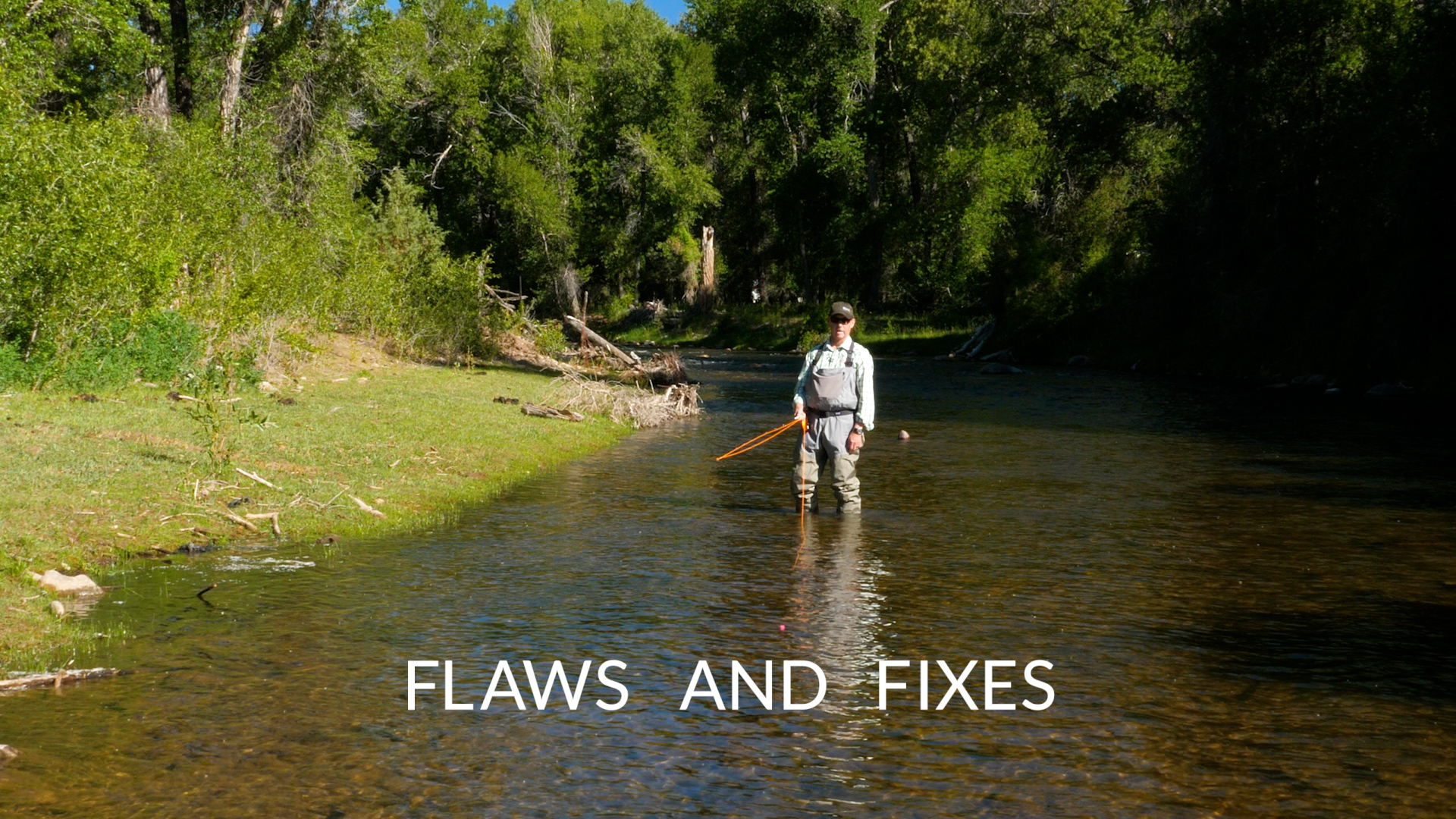
First, creep. Creep (Figure 5) is when an angler makes a cast and while waiting for their loop to straighten, they “creep” the rod forward slowly rather than keeping the rod still. When this happens it means that more force must be applied to the next cast, in a shorter distance, which causes the rod to bend more. It looks like this:

The cure for this very common problem is simple. Make sure that as you are waiting for your loop to open before making the next cast, you hold the rod very still, don’t let it “creep” forward. Even a little bit of creep will cause a problem.
The other very common cause for tailing loops is how a caster accelerates the fly rod. For the rod to bend properly, it must accelerate very smoothy. Rod acceleration must be the same from the start of the cast to the end. This is accomplished when the caster also applies force to the rod very smoothly. Many casters think that the fly rod should accelerate slowly early in the casting stroke, then accelerate much faster at the end. That acceleration causes tailing loops. Figure 6 illustrates this.

The cures to this problem are also very simple. First, determine if the line speed of the cast is appropriate. If line speed is excessive, that is, if the loop is going faster than necessary to get the fly to the target, the cure is to simply not accelerate the rod faster at the end of the casting stroke. In many cases this acceleration is like a “punch” of extra power at the end of the cast. Eliminate that and rod acceleration at the end of the cast will more closely match rod acceleration at the beginning and the rod tip path will be straighter and the loop won’t “tail”.
It’s important to remember that speed and acceleration are not the same thing. Speed is simply how fast something is going. Acceleration is about how speed increases. Every fly cast starts with rod and line speed being slow and ends with line and rod speed being fast. How the rod and line go from slow to fast is acceleration.
If line speed is deemed to be appropriate for the intended cast the cure is different, of course. If line speed is OK then the problem is caused by rod acceleration at the beginning of the casting stroke being too slow. If rod/line acceleration in the beginning of a cast are too slow the fix is obvious, increase rod acceleration early in the cast but don’t change it at the end. This will result in smoother rod bend and a straighter rod tip path, and a better loop that won’t tie knots in your leader.
A key universal rule in casting is that the line follows the path of the rod tip. The key thing to remember about tailing loops and leader knots is that the cause is a dipping rod tip path. Avoiding creep and accelerating the rod very smoothly will straighten the rod tip path and cure almost all tailing loops.



Dave L
SA, great content!. The article makes the point clearly and simply, the drawn visual illustrates it, and the video demonstrates both. I think I now understand “wind knots” well enough to help me diagnose and eliminate my own casting problems, and how to explain the issue and help others. They’ve been a nagging and persistent problem for me over many years and I think I can finally put them to rest. Thanks for posting.