Special Delivery | Taking Skagit to the Next Level
Taking Skagit to the Next Level
Taking Skagit to the Next Level. Few things have helped to increase the popularity of swinging flies for steelhead and salmon like the use of Skagit lines. Named from their development on Washington’s Skagit River, these versatile lines have simplified Spey two-handed casting and allow the use of weighted flies and heavy sink tips. This has opened up a lot of areas for use with flies that could not be approached previously. Deep, fast runs that could not be approached by the use of traditional-style lines and flies were now fishable.
Let’s do a quick review of a standard Skagit setup. The line itself is short, usually in the 25 foot or less range. It is floating, in a heavy grain weight with a minimal taper and attached to a thin running line by a loop-to-loop connection. Various length and density sink tips are looped to the end of the line based on the depth and current speed being fished. Often a weighted fly is used to achieve maximum depth. Standard Spey casting principles are employed, but adjustments are made to compensate for shorter lines and turning over heavy tips and flies. Think of it as a continuous motion casting stroke. One would not call it “pretty” casting. Rather it is a means to an end- getting the fly to the fish and still being able to swing it properly.
As the popularity of swinging flies has grown, its’ application has expanded to marginal conditions in a number of areas. This would include the extreme cold water of winter steelheading in the Pacific Northwest and Great Lakes. The high, early-season flows for Atlantic salmon and the heavy flows when chasing King salmon are additional uses. Floating Skagit lines have proven their worth in these situations, but also have their limitations. There is only so much T-18 or 20, or so big a rabbit-strip fly that can be turned over on given grain weight.
One solution once this maximum has been reached is to consider an intermediate Skagit line. Scientific Anglers introduced some of the first of these style lines around a decade ago. Intermediate lines are PVC without any floatation added. No microballoons or additives aid floating, so the line sinks slowly. This allows it to get below any surface currents or influence of wind and helps slow the swing. A tip of less density and lighter fly may also be usable. There is also a better straight-line connection to the fly on the swing as the “hinge” created by a floating line and heavy tip is eliminated. Bottom line- more fish hooked in extreme conditions.

Using an intermediate Skagit line has a bit of a learning curve. It does require more lift to get out of the water. You may have to give it a roll to the surface before making your set up move for the final presentation. If wading, extra attention needs to be given to minimize hang ups and snags. What this line does give you is another tool to use under extreme conditions when the floating Skagit just can’t do the job properly.
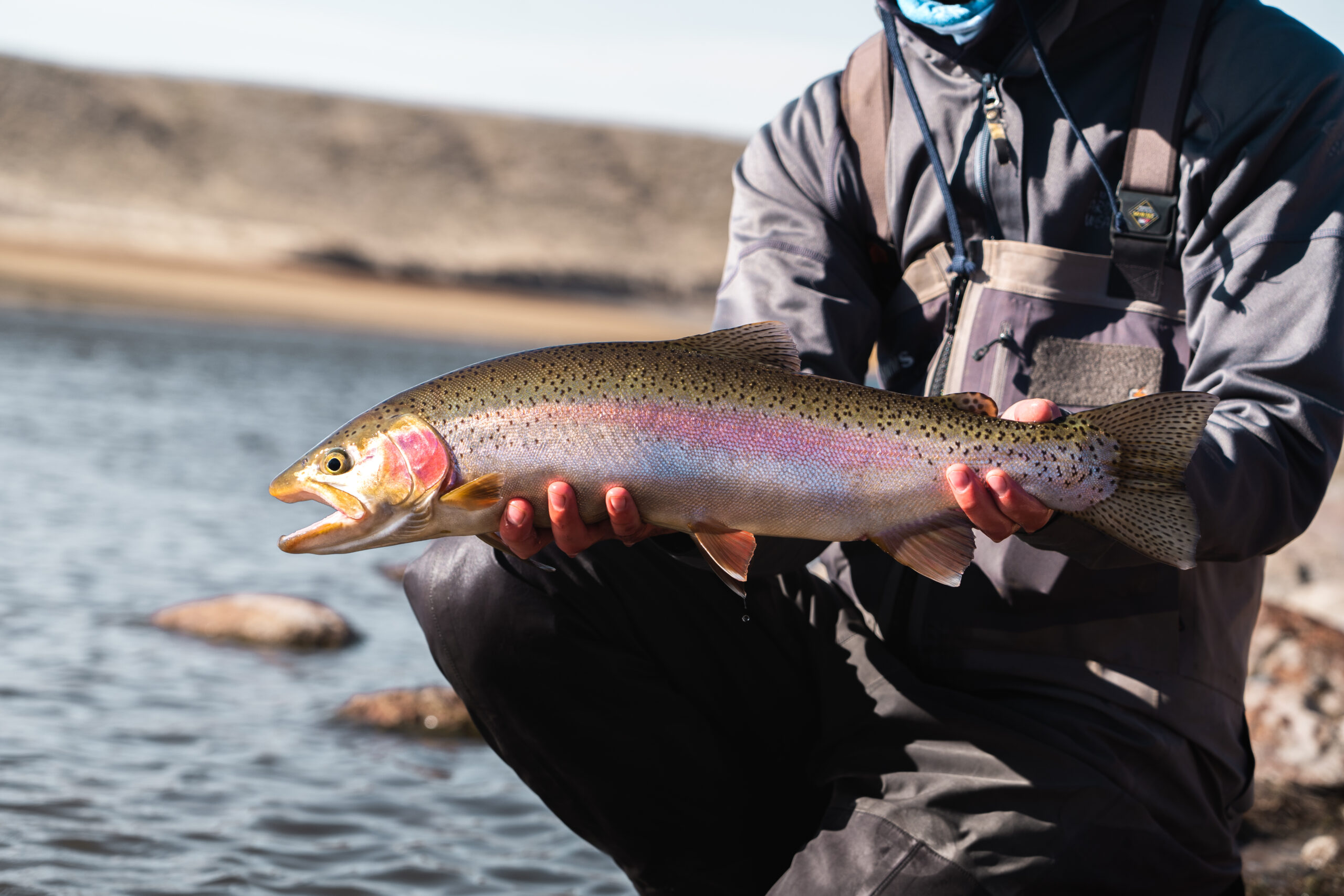
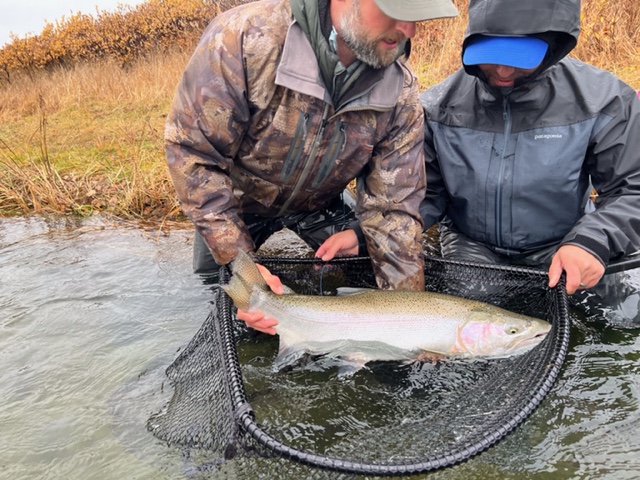
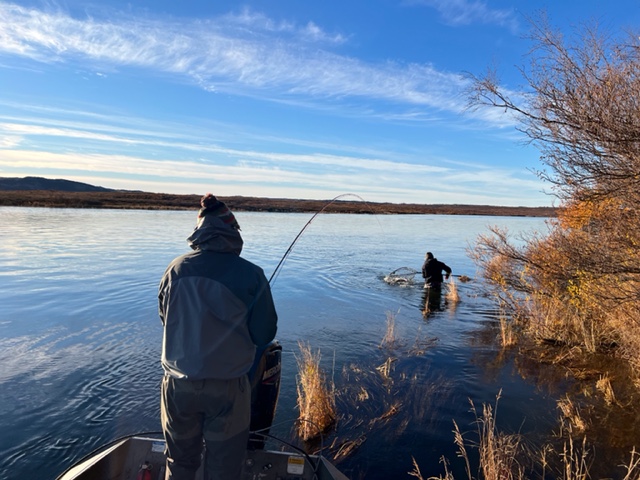
A recent trip to Alaska was clear proof of this. Fishing the Naknek River for large coastal rainbows, flows were already a couple feet above normal due to excessive summer rains. A cold front moved in and nighttime temperatures dropped to 15 degrees, causing the water temp to crash. This moved the oversized Naknek rainbows off the shallow bars to the deeper edges. Floating lines were nearly useless as the tips and flies needed to get down were almost impossible to turn over, even for experienced casters.
The Intermediate Skagit lines saved the trip the group. We were able to get flies to the right level in the water column moving at the right speed. The result was multiple fish on the swing for most everyone in the group, with a number getting personal best rainbows. Any line with a floating portion to it just didn’t fish as effectively. The intermediate line also casts better in the wind as it has a smaller diameter for the same grain weight. If you are serious about swinging flies in all conditions, an intermediate Skagit line is an important addition to your equipment.

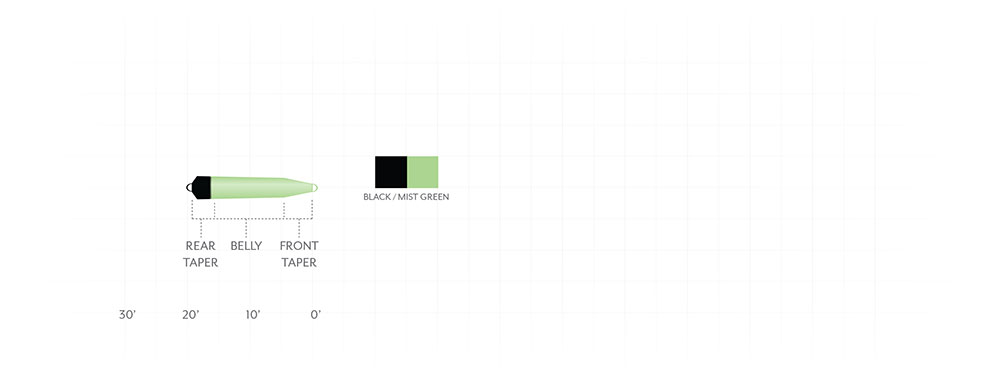
You can check out Scientific Anglers Intermediate Skagit offerings at Skagit Intermediate | Scientific Anglers. These lines are available from 420 gr. to 600 gr. As far as tip lengths and densities, we try to keep length around the length of the rod and maximum densities as follows:
Grain Weight T Size
420 gr. T-12
450-510 gr. T-14
540-570 gr. T-18
600 gr. T-20
Scientific Anglers TC Textured Spey Tips can also be used with Intermediate Skagit lines. These tips are available in 3 lengths (8’, 10’, 12’) and both single and double-density configurations. They are looped on each end for quick on-and-off and also tapered for a more efficient turnover of the fly. They also have textured finish that reduces water friction, giving improved sinking and less drag on pick-up to recast. As a point of reference, the Sink 7 TC Tip performs similar to T-14.
This may allow a lighter density tip to be used with similar success. When combined with an Intermediate Skagit, we find that this is often the case. The swing speed can be slowed significantly and a lighter tip used. In a fast, shallow run this can also help reduce snags. Having both floating and intermediate heads allows maximum swing and presentation control across a full range of depth and current speeds.